Last Updated: 0/0/22 (Jump down to New/Additional Information)
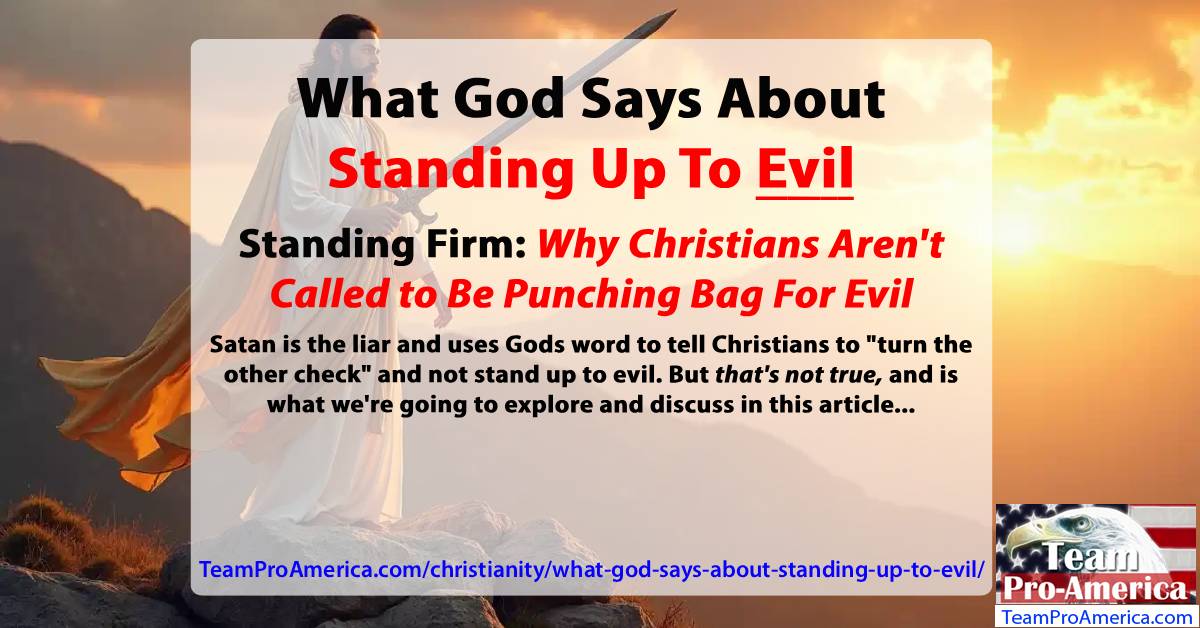
What God Says About Standing Up To Evil
Satan is the liar and uses Gods word to tell Christians to "turn the other check" and not stand up to evil. But that's not true, and is what we're going to explore and discuss in this article...
More...
Typical of Satan and the Left, they either use God's word out of context, or they only tell you part of the story and not the whole story. Let's dig in...
Standing Firm: Why Christians Aren't Called to Be Punching Bags for Evil
In a world increasingly hostile to faith, many Christians grapple with a profound misunderstanding: the idea that following Jesus means passive submission to evil. Phrases like "turn the other cheek" are often weaponized to suggest believers should endure abuse, violence, or injustice without resistance, essentially becoming "punching bags" for the wicked.
This distorted view not only misrepresents Scripture but also empowers evil by disarming the righteous.
The Bible, however, paints a far more robust picture—one where love for enemies coexists with bold confrontation, self-defense, and the active dismantling of evil.
Drawing from God's Word, this article explores why Christians are not called to endless passivity but to stand firm, protect the vulnerable, and overcome evil with godly wisdom and strength.
The Part Of The Bible Satan & The Left Pushes As To How Christians Should Act When Faced With Evil...
To begin, let's address the elephant in the room: Jesus' teaching on turning the other cheek. In Matthew 5:38-44, Christ says, "You have heard that it was said, 'Eye for eye, and tooth for tooth.' But I tell you, do not resist an evil person. If anyone slaps you on the right cheek, turn to them the other cheek also... Love your enemies and pray for those who persecute you."
At first glance, this seems to advocate total non-resistance. Yet, context is crucial.
In the ancient Near East, a slap on the right cheek was typically a backhanded insult—a gesture of humiliation rather than life-threatening violence. Jesus is addressing personal offenses and the cycle of petty retaliation, urging His followers to respond with dignity and grace to break the chain of hatred. This is not a blanket prohibition against all forms of self-defense or confrontation; it's a call to transcend base instincts and reflect God's mercy.
Here are some scriptures about "loving our enemy" that Satan and the Left push out of context in the way they push these scriptures. It's true, the Bible clearly instructs believers to respond to evil with love, aiming for redemption rather than revenge. This counters hatred but doesn't mean ignoring threats.
- Matthew 5:38-44: Jesus says, "You have heard that it was said, 'Eye for eye, and tooth for tooth.' But I tell you, do not resist an evil person. If anyone slaps you on the right cheek, turn to them the other cheek also... Love your enemies and pray for those who persecute you." This focuses on personal insults or minor harms, promoting non-retaliation to break cycles of violence and reflect God's character.
- Romans 12:17-21: "Do not repay anyone evil for evil... If your enemy is hungry, feed him... Do not be overcome by evil, but overcome evil with good." Paul emphasizes that vengeance belongs to God (v. 19), so our role is to extend grace, which can "heap burning coals" on the enemy's head—potentially leading to repentance.
- Luke 6:27-28: "Love your enemies, do good to those who hate you, bless those who curse you, pray for those who mistreat you." This is about proactive kindness, not enabling harm.
These passages show that "only presenting love" is a core principle for personal interactions, but it's not the full picture—especially when evil endangers lives, justice, or communities. The Left ONLY presents the above points and scriptures to push people to be submissive to evil. Here's the rest of the story...
Standing Up To Evil
Consider the broader Sermon on the Mount. Jesus isn't promoting victimhood but kingdom living—where believers prioritize eternal values over immediate vengeance. He Himself didn't passively accept every evil act.
In John 2:13-17, Jesus enters the temple, fashions a whip, and drives out the money changers who were exploiting worshippers. Overturning tables and scattering coins, He declares, "How dare you turn my Father's house into a market!"
This was a direct, physical confrontation with systemic evil, showing that righteous anger has a place when God's holiness is at stake. If Jesus—the embodiment of love—could aggressively oppose corruption, how much more should we resist evil that harms the innocent?
The Old Testament further reinforces this. God's law explicitly permits self-defense. In Exodus 22:2-3, it states, "If a thief is caught breaking in at night and is struck a fatal blow, the defender is not guilty of bloodshed."
This Mosaic principle acknowledges the right to protect one's home and family, even lethally if necessary. It's not about bloodlust but preserving life against unlawful aggression.
Similarly, in Nehemiah 4, when enemies threatened the Jews rebuilding Jerusalem's walls, Nehemiah didn't counsel passive prayer alone. He armed his workers: "Those who carried materials did their work with one hand and held a weapon in the other" (Nehemiah 4:17). He rallied them, saying, "Don't be afraid of them. Remember the Lord, who is great and awesome, and fight for your families, your sons and your daughters, your wives and your homes" (Nehemiah 4:14).
Here, faith and action intertwine; standing up to evil meant preparing for battle while trusting God for victory.
This theme carries into the New Testament. In Luke 22:35-38, as Jesus prepares His disciples for a perilous future, He instructs, "But now if you have a purse, take it, and also a bag; and if you don’t have a sword, sell your cloak and buy one." Swords were defensive weapons, implying readiness to protect oneself in a dangerous world.
While Jesus later rebukes Peter for using a sword impulsively in the Garden of Gethsemane (Matthew 26:52: "All who draw the sword will die by the sword"), the point is discernment—not absolute pacifism. The sword isn't for offensive conquest but for defense against threats.
This aligns with Romans 13:3-4, where Paul describes governing authorities as "God's servants, agents of wrath to bring punishment on the wrongdoer," bearing the sword (a symbol of justice) to curb evil. If civil powers are divinely ordained to confront wickedness, individual believers aren't expected to stand idly by when evil strikes.
Scriptures On Protecting Ourselves and Others from Evil
The Bible affirms self-protection and defense, particularly when evil attacks the vulnerable. God doesn't expect passive suffering in the face of aggression; instead, He equips and empowers resistance.
- Exodus 22:2-3: In the Mosaic Law, "If a thief is caught breaking in at night and is struck a fatal blow, the defender is not guilty of bloodshed." This explicitly allows lethal self-defense in home invasions, showing God values protecting life and property.
- Nehemiah 4:13-14, 17-18: When rebuilding Jerusalem's walls amid threats, Nehemiah armed his people: "I stationed some of the people behind the lowest points of the wall... with their swords, spears and bows... Those who carried materials did their work with one hand and held a weapon in the other." He urged, "Remember the Lord... and fight for your families." This demonstrates organized defense against evil forces.
- Luke 22:35-38: Jesus tells His disciples, "But now if you have a purse, take it, and also a bag; and if you don’t have a sword, sell your cloak and buy one." This suggests preparation for self-defense in a hostile world, though He later clarifies not to rely on violence as a way of life (Matthew 26:52: "All who draw the sword will die by the sword").
- Psalm 82:3-4: "Defend the weak and the fatherless; uphold the cause of the poor and the oppressed. Rescue them from the hand of the wicked." God commands active intervention to protect others from evil, implying confrontation when necessary.
- Proverbs 24:11-12: "Rescue those being led away to death; hold back those staggering toward slaughter. If you say, 'But we knew nothing about this,' does not he who weighs the heart perceive it?" This rebukes inaction in the face of evil, urging rescue efforts.
These verses indicate that God wants us to protect ourselves and others—using wisdom, not recklessness. Self-defense is justified, but it should be proportionate and not rooted in hatred.
Scriptures On Destroying or Confronting Evil Aggressively
When evil is systemic, oppressive, or directly opposed to God, the Bible shows examples of decisive action, including destruction, often under divine command. This isn't vigilantism but God-ordained justice.
- Spiritual Evil: For demonic or internal evil, confrontation is spiritual: Ephesians 6:12: "Our struggle is not against flesh and blood, but against... the spiritual forces of evil." Use prayer, truth, and God's Word to "destroy arguments and every lofty opinion raised against the knowledge of God" (2 Corinthians 10:4-5). James 4:7: "Resist the devil, and he will flee from you."
- Physical or Moral Evil: Biblical heroes confront and destroy evil when it attacks God's people:
- David vs. Goliath (1 Samuel 17): David slays the Philistine giant who defies God and threatens Israel, saying, "You come against me with sword and spear... but I come against you in the name of the Lord." This is aggressive defense, destroying evil to protect the community.
- Jesus in the Temple (John 2:13-17): Jesus makes a whip and drives out corrupt money changers, overturning tables. He confronts evil exploitation physically, showing righteous anger against those perverting God's house.
- Old Testament Wars: God commands Israel to destroy evil nations (e.g., Deuteronomy 7:1-2 against Canaanites practicing idolatry and child sacrifice) to prevent corruption. While these are specific to ancient theocracy, they illustrate God's hatred of evil (Psalm 97:10: "Let those who love the Lord hate evil").
- Romans 13:3-4: Civil authorities "do not bear the sword for no reason. They are God’s servants, agents of wrath to bring punishment on the wrongdoer." Governments (and by extension, law enforcement or military) are divinely authorized to confront and destroy evil through justice.
- Revelation 19:11-21: In the end times, Jesus returns as a warrior to destroy evil definitively, with "a sharp sword" from His mouth (His Word) and treading the winepress of God's wrath. This shows ultimate victory over evil involves its destruction.
The key distinction: Personal enemies get love and prayer, but institutionalized or attacking evil may require stronger measures—like legal action, defense, or exposure (Ephesians 5:11: "Expose the deeds of darkness"). God doesn't want us to be doormats; He equips us to stand (Ephesians 6:13).
Biblical Heroes Who Further Support Our Needing To Stand Up To Evil...
Biblical heroes exemplify this balance. Take David, the shepherd boy who became king. Facing Goliath, a giant who mocked God and terrorized Israel, David didn't turn the other cheek. Armed with a sling and unshakeable faith, he declared, "You come against me with sword and spear and javelin, but I come against you in the name of the Lord Almighty" (1 Samuel 17:45).
He struck down the Philistine, not out of personal grudge, but to defend his people and honor God. This wasn't murder; it was the destruction of evil that sought to destroy the righteous.
Likewise, in the book of Esther, when Haman's plot threatened genocide against the Jews, Queen Esther didn't passively accept fate. She risked her life to expose the evil, leading to the Jews' right to defend themselves: "The Jews struck down all their enemies with the sword, killing and destroying them" (Esther 9:5). God used human agency to thwart evil, showing that prayer alone isn't always sufficient—action is required.
Spiritual Warfare
On a spiritual level, the Bible frames our battle against evil as warfare, not surrender. Ephesians 6:10-17 (one of my most favorite scriptures) urges...
"Put on the full armor of God, so that you can take your stand against the devil’s schemes. For our struggle is not against flesh and blood, but against the rulers, against the authorities, against the powers of this dark world and against the spiritual forces of evil in the heavenly realms."
This armor includes the "sword of the Spirit, which is the word of God"—a tool for offensive resistance.
James 4:7 commands, "Resist the devil, and he will flee from you." Resistance implies active opposition, not passive endurance. Even in personal encounters, Ephesians 5:11 instructs, "Have nothing to do with the fruitless deeds of darkness, but rather expose them." Calling out evil—whether through words, legal means, or protective measures—is part of our mandate.
Scriptures Teach Us To Be Defensive, NOT Offensive, And To Have Love As The Foundation!
Yet, this isn't a license for vigilante justice or hatred. The Bible insists on overcoming evil with good (Romans 12:21). Love remains the guiding principle: pray for enemies (Matthew 5:44), seek reconciliation (Luke 17:3), and hate evil itself, not the evildoer (Psalm 97:10: "Let those who love the Lord hate evil").
Proverbs 24:11-12 warns against inaction: "Rescue those being led away to death; hold back those staggering toward slaughter." If we claim ignorance or fear as excuses, God sees through it. In modern terms, this means reporting abuse, defending the unborn, standing against tyranny, or even using force in self-defense scenarios like home invasions or assaults. Organizations like International Justice Mission, which rescues victims of trafficking, embody this by confronting evil head-on while extending grace.
Misconception That Christians Need To Be A Punching Bag...
The misconception of Christians as "punching bags" often stems from cultural pressures or selective reading of Scripture.
In reality, passivity can enable evil, allowing it to flourish unchecked. History shows the cost: during the Holocaust, some churches remained silent, while others like Dietrich Bonhoeffer actively resisted Nazi evil, even plotting against Hitler. Bonhoeffer, executed for his stance, wrote, "Silence in the face of evil is itself evil: God will not hold us guiltless." His life echoes the biblical call to action.
Conclusion
In conclusion, Christians are not doormats for evil.
We're warriors in God's army, equipped to love fiercely while standing unyieldingly against wickedness.
Turn the other cheek to insults, but wield the sword of truth and justice against threats to life and faith.
As Psalm 82:3-4 implores, "Defend the weak and the fatherless; uphold the cause of the poor and the oppressed. Rescue them from the hand of the wicked."
Let us discern wisely, act boldly, and trust God for the outcome. In doing so, we honor Him and protect His creation from the ravages of evil.
Now you know the rest of the story!
New/Additional Information:
Header
Content